The
President’s Message:
I will be presenting a program about the use
of checks during the Civil War. This is an interesting aspect of the
War.
The Round Table is in need of programs for
the May and June meetings. If you have an idea for a presentation,
please let me know.
Gerridine LaRovere
Presentation
March 11, 2026
This is Robert Krasner’s presentation:
What Robert E. Lee Experienced and
Learned During the Mexican War That Was Applicable during the Civil War.
What was Robert Lee E. Lee doing in Mexico and why is he there?
Now I'll just throw one date, December 29th, 1845.
This is an important opening statement.
Texas is annexed by the U.S. and becomes the 28th
state. But here's where we
begin. Mexico claims Texas
is still part of Mexico.
Around 1846, General Mariano Paredes y Arrillaga came to power as
President of Mexico. It's
not a name you'll see a lot.
He does not want to meet with the U.S. representative in Mexico about
the boarder. The U.S. Army
begins to march to the Rio Grande River.
Mexico will defend against a U.S. invasion of Texas.
President Polk ordered General Taylor and his
forces south to the Rio Grande.
Taylor ignored Mexican demands to withdraw to the Nueces.
He constructed a makeshift fort on the banks of the Rio Grande
opposite the city of Matamoros.
On April 25, 1846, a 2,000-man Mexican cavalry detachment, led by
General Mariano Aristo, crosses the Rio Grande and attacks.
There was a skirmish at Rancho Carricitos.
46 U.S. soldiers are captured.
A month later, General Taylor takes 3,200 men and he goes to Port
Isabel. He needs supplies.
The Mexican troops fire a cannonball and they hit the fort at
Port Isabel. General Taylor
leaves Point Isabel with the supplies.
This begins a series of small battles.
On May 3, 1846 the Mexican artillery at
Matamoros opened fire on Fort Texas, which replied with its own guns.
The bombardment continued for 160 hours and expanded as Mexican
forces gradually surrounded the fort.
Thirteen U.S. soldiers were injured during the bombardment, and
two were killed. Among the
dead was MAJ Jacob Brown, after whom the fort was later named.
During the Battle of Resaca de la Palma on
May 9, 1846, the two sides engaged in fierce hand-to-hand combat. The
U.S. Cavalry managed to capture the Mexican artillery, causing the
Mexican side to retreat, which then became a rout.
Fighting on unfamiliar terrain, his troops fleeing in retreat,
Arista found it impossible to rally his forces.
Mexican casualties were significant, and the Mexicans were forced
to abandon their artillery and baggage.
The U.S. Congress approved
the declaration of war on May 13, 1846.
Robert then began a brief outline of the progress of American
troops in the occupation of Mexico.
You had the Battle of Monterey, which is September 1846.
Then, in February 23, 1847, the Battle of Buena Vista; a U.S.
victory. There is a hero in this battle.
I'll give you a hint. He
became president of the Confederacy.
On March 9, 1847, you had the siege of Vera Cruz.
Then by September 1847, you had the Battle of
Chapultepec. Another man becomes a hero. He lobs cannon
balls into the fort. And I'll give you a little hint at him.
He's at the Battle of Bull Run. And they said he stands there like
a stone wall. The war ended with the Treaty of Guadalupe Hidalgo.
And there you have it, the whole war.
We will now focus on Robert E. Lee.
Captain Lee was still occupied with the defenses of New York.
When on August 19, 1846, he received orders that put him on the
direct path to fame, orders to report to Brigadier General John E. Wool
in San Antonio, Texas, for service in the recently declared war.
Within six weeks Lee is with Wool.
And by mid-October was across the Rio Grande, riding south with
the commander as the force made its way toward a junction with, and this
is a man you've heard of, General William T. Worth's wing of Taylor’s
army. He distinguishes
himself in the building of roads and bridges for Wool's rapid march and
in the boldness and persistence of, it's a very important word for Lee,
reconnaissance. He was
rewarded for these efforts by being promoted to Acting Inspector General
of Command.
January 1847, Lee's orders transfer him to
the Staff of General Scott.
Robert E. Lee is part of Twiggs' division that is leaving Veracruz and
is headed to Jalapa, about 60 miles northwest of Veracruz.
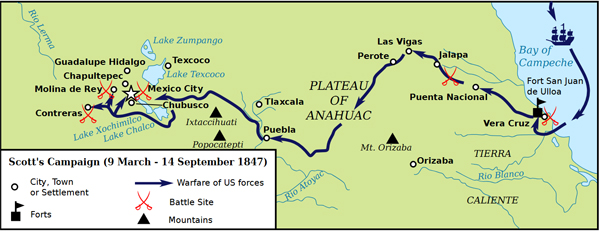
April 12th, General Scott is
marching inland from Veracruz with Lee.
They soon cross the river called Rio de Plan.
Santa Anna and his enemy troops are located on a mountain pass
with a force of may be 12,000.
The passes and the bridges are held by Mexican batteries.
General Twigs is part of a division and he wants to attack by
April 13th, but he is held back by Major General Robert
Patterson, who is in command.
Scott orders a full reconnaissance.
Lee is to participate in the reconnaissance and find out if the
enemy's position can be turned.
Here is what Lee finds out.
Santa Anna has chosen his ground well.
The right of the Mexican line overlooks the river on the bluffs.
There is no way you're going to turn the right side of that line.
What to do?
Our goal is to get to Jalapa.
There is the National Road to get there.
As they approach Cerro Gordo, the battle site just south of
Jalapa on the above map, they are faced with a 1,000-foot-high plateau.
On top of a hill 35 cannons face the American troops.
The solution is finding a path through heavy ravines on the
Mexican left-hand side of the line where they're exposed.
Lee felt it would be possible for the troops to pass.
Lee sees a spring, a little water flowing from somewhere.
A path is coming from somewhere south and it seems to be
well-traveled. Lee sees some
broken bushes. Conclusion.
That's got to be the rear of the Mexican left flank.
He hears voices in Spanish; they must be
soldiers. Lee hides behind
logs. They're covered by
dense rushes. Nearby, the
Mexican troops are drinking water from the spring.
Lee wasn't by himself.
Lee is not alone. He
has a partner, named John Fitzwater.
He was just like a tour guide.
I think he might have been a general.
They hide. But if the
Mexicans see footprints, they will be found and the reconnaissance will
never be heard of again. A
Mexican soldiers pass over logs where they are hidden.
If the soldier trips, he's going to fall and hit Lee.
Luckily, he does not and the remaining soldiers leave.
I got this from Douglas Southhall Freeman's book.
It should be accurate. Three feet away!
Lee returns to the American lines using his
experience as a boy when he walked along King George's meadows in
Alexandria, VA. He had
developed a set of directional skills.
He understands land.
The results? Headquarters
does not seem to be satisfied.
Scott told Lee, next day continue the recon with a working party
and cut a trail. On April 16th,
the Lee team didn't reach the road to Jalapa.
But they were convinced the trail they were building is going to
be pretty close. Scott makes
a decision. We better stay
in the valley and continue this.
Why? This is a very
important idea that is going to really have a major impact on the Civil
War. Yellow fever season is
coming. Scott sent Twiggs’
division around Santa Ana's flank using Lee to be the guide.
The battle is about to open on April 18th
with the aid of General Worth.
How many men? Again,
I don't know if these figures are accurate but the best guess is 1,600
men. On April 17th.
Lee will have the heaviest responsibility he has ever known.
Here is the plan. The
army will first feint to the Mexican right.
Twiggs' division is going to go in the center of the Cerro Gordo
Plateau, where a small hill is.
They storm the mountains, knock out the batteries, and then block
the Mexican retreat to the road.
The balance of Twigs' forces eventually, totally, should envelop
the Mexican forces. The
light guns have to be pulled to the top of that hill.
On April 17th, Lee has two special
duties. First, he's got to
get batteries onto that hill.
The battle begins, with opening fire at sunrise on April 18th.
The goal from Scott is to fire at the hill.
And, simultaneously, while we're firing, a brigade is supposed to
get on the other side of the hill.
So, you have an idea what they're trying to do.
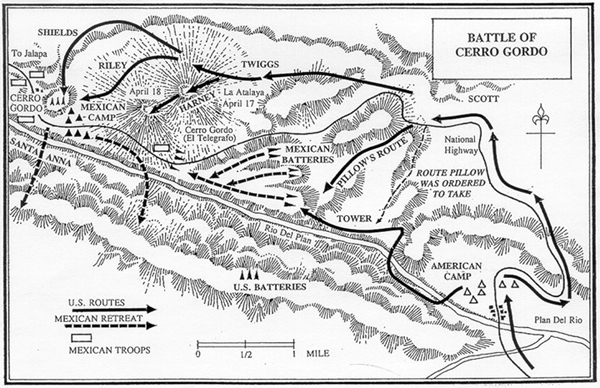
If you look at the above map it is labeled
RILEY representing Riley's brigade.
You can also see Shields brigade.
These are names you'll see, in the different campaigns,
especially in the valley.
They get to the main road, the National Road, to Jalapa.
And the result is the entire center and left of the Mexican
position was occupied. So,
they win. There are two
hills in front of the main road.
The right side of Santa Anna’s army near the river is cut off.
The right side was attacked.
Pillow came in here and he tried to attack.
It was prematurely and somewhat of a failure.
But Patterson's division (not labeled on the map) in the center
became involved and found the road.
Approximately 3,000 Mexican troops were
captured and most of the Mexican artillery.
And this is going to be used, this Mexican artillery that was
captured, in some of the major battles towards the end.
At the beginning, the Mexicans had 8,000 troops, Scott 9,000.
Okay. U.S. losses weren't
too much, 263 killed, 368 wounded.
Lee's action at Cerro Gordo was his first open engagement.
He realizes now the pain of war.
He was a captain of engineers.
He had been one of two officers to find a route on which the plan
of battle had been based. He
had successfully led the turning column on both days.
His reasoning as to the position of the enemy and the location of
the Jalapa Road had been correct.
He had disclosed a special aptitude for reconnaissance.
The possession of this quality is praised by Scott.
He's learning a lot.
Now let us examine briefly General Scott's
report and see how Lee outdid his lieutenants.
It's not really too detailed and I'll just summarize it.
“In expressing my indebtedness for able assistance to Lieutenant
Colonel Hitchcock, Acting Inspector General, Majors Smith and Trumbull,
Chiefs of Engineers, Topographical Assistance, Lieutenants Mason,
Beauregard, Stevens, Tower, G.W. Smith, McClellan, Lieutenants Derby,
Hardcastle, Topographical Crew, Captain Allen, Chief Quartermaster,
Lieutenant Blare, Chief Commissary, Lieutenants Hagner, Laidley,
Ordnance. I am impelled to
make a special mention of the services of Captain R.E. Lee Engineers.
This officer greatly distinguished at the siege of Vera Cruz was
again indefatigable during the operations and reconnaissance as daring
as laborious, and of the utmost value in scouting, planning batteries,
and conducting troops to their positions under the heavy fire of the
enemy. He showed
persistence. On August 24th,
though he did not get the news till much later, Lee was brevetted Major
to date from April 18, 1847 for gallant and meritorious conduct in the
Battle of Jalapa.”
You can see on your first map, that Scott
moved on to Perote, which General Work took without opposition.
There, Lee had to verify inventory, arms, ammunition.
Although the Army is short of needs, Scott ordered General Work
to Pueblo (120 miles from Jalapa) which at the time, is the second
largest city in Mexico.
Puebla is 186 miles from Vera Cruz.
From Puebla, the distance to Mexico City is 93 miles.
So, we take 186 and 93 and Lee's gonna be on this long march of
279 miles. This will have an
effect on Lee's decisions.
I'll get into that later.
On August 7th, Brigadier General
Franklin Pierce, you should know his name as he became president, enters
Pueblo with 2,500 troops, making the Army’s total now 10,738 troops.
Again, I mentioned Franklin Pierce, well-known figure.
I could have included what Pierce did, but I didn't want to make
this talk too long. After
his arrival, Scott put Twigg's division on the road to Mexico City.
The question at the time was, where would
Santa Anna make his stand? I
didn't know. On August 12th,
Scott establishes his headquarters at Ayotla, about 19 miles to Mexico
City. This is not shown on
the first map, but it is at the arrowhead under the label Mexico City.
You can see that on the first map the approaches to Mexico City.
Here lies Lake Texcoco on the north and Lakes Xochimilco and
Chalco on the south. And
looking at the map, a route between the lakes isn't feasible.
Well then, what do we do?
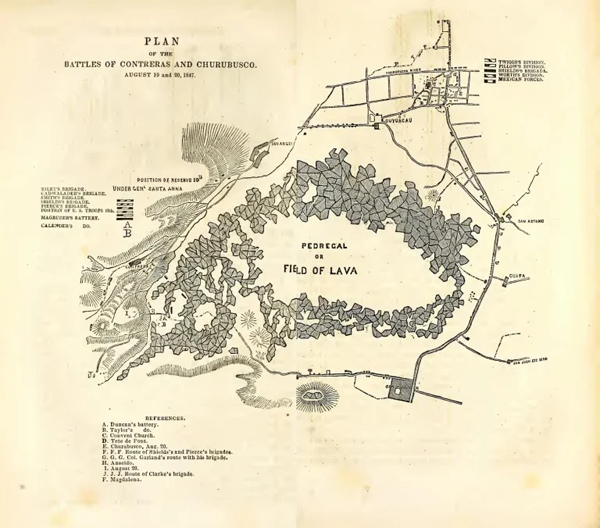
Robert E. Lee made a map of reconnaissance
south and west of Lake Chalco.
A route from the town of San Antonio, Mexico, is just to the east
of a great field of lava is possible.
This is a big chunk of lava five miles from east to west and
three miles running north and south.
They needed to find a route around the lava bed.
Finding a way over the southern tip falls to
Robert E. Lee. Lee is given
authority to do this with 500 men from Pillow’s Division, to lay a track
across that lava bed. And
they're going to move goods and heavy artillery.
That is a job. The
team moves from San Agustin east, you see that on your map, towards the
west. But, never perhaps in
American history did a small column contain so many men who would become
famous in the Civil War.
Now, Lee is in charge of reconnaissance.
In that band could be found, G.T. Beauregard
Lee’s assistant. G.B. McClellan, the engineer, Gustavia Smith, a captain
Joseph Hooker, an assistant to Pillow, J. Bankhead Magruder, the light
batteries, and T.J. Jackson (Stonewall), Magruder's lieutenant.
The Mexican forces are heading south through the San Angelo Road
and they're visible. The
best solution is going to be to sweep around the road and turn the left
side of their line.
Scott splits his troops up south of the main
road and north of the main road so that he can position his troops on
the flank and on the rear.
This was the challenge that Lee had.
To scout for a route on the west side of the lava bed.
On the first trip, Lee and his men navigated the dangerous
terrain at night in a rainstorm to determine the location of Mexican
forces on the other side. On
the second trip, Lee returned this time, guiding additional U.S. troops
in the lava field to launch a surprise attack on the Mexican forces. The
result: Lee's successful navigation of the lava field enabled a surprise
attack that led to the crucial victory of the American forces.
Lee’s force makes its way around and arrives at the village of
Coyuacau. Finally, a battle
takes place at Churubusco just to the north.
Praise of Lee comes in from a number of
sources. General Twiggs
wrote of him, to Captain Lee of the Engineers, I have again the pleasure
of tendering thanks for services rendered during the occupation.
General P.T. Smith, admiration for the conduct of Captain Lee of
Engineers, his reconnaissance beyond his bounds with skill, judgment,
personal dare are conspicuous.
General Pillow, I cannot in justice omit to notice valuable
services of Captain Lee of Engineers, core gallantry of highest grace.
The lessons he learned, and never forgot, on
the road to Mexico City, he applied in much of his later strategy.
The following are seven lessons Lee learned from Cerro Gordo to
Mexico City in strategy and the handling of an army.
First, when it is remembered that the son of light horse Harry
Lee received his practical instruction in that particular campaign under
as daring a soldier as Scott and followed that by a study of Napoleon it
will not be surprising that audacity even to the verge of seeming
overconfidence was the guiding principle of the strategy he employed as
the leader of, they used the word desperate, that's debatable, let's
just say the leader of a cause.
Lee concluded, number two from Scott's
example, that the function of a commanding general is to plan the
general operation to acquaint the corps commander with that plan and to
see that their troops are brought to this scene of action at the proper
time. It is not the function
of the commanding general to fight the battle in detail.
Lee's later methods in this respect are simply those of Scott,
whether he was right in this conclusion is one of the questions of his
career.
Third, working with the trained staff, Lee
saw its value in the development of a strategic plan.
Scott was very careful on this score although he could not keep
the administration from naming politicians to command some of his
divisions, he could surround himself with men who had been well grounded
in discipline, promptness and accurate observation.
He did not exaggerate when he said publicly in Mexico, he could
not have succeeded in his campaign had it not been for West Point.
Scott relied on the young men who had been trained at the
military academy and they did not fail him.
Reconnaissance became second nature and is
point four. The relationship
of careful reconnaissance to sound strategy was impressed on Lee by
every one of the battles he saw in Mexico.
In point five Lee saw in the field the
strategic possibilities of flank movement.
Cerro Gordo had been passed and San Antonio, Mexico had been
turned by flanking the enemy.
At the little cost of life, positions of much strength had been
rendered untenable. There,
too, were lessons that he never forgot.
Second Manassas, or Second Bull Run, was Cerro Gordo on a larger
terrain.
Lee acquired a confident view of the
relationship of communications to strategy as point six.
He saw Scott at Puebla boldly abandon his line of supply from the
sea and live off the country.
Within 37 days, Scott had battered his way into Mexico City.
It is quite possible that this experience was one reason why Lee
was emboldened to expose his communications in the Maryland Campaign of
1862 and in the Pennsylvania Campaign of 1863.
For the seventh point Lee acquired in Mexico
an appreciation of the value of fortification.
The proper location of the batteries at Veracruz and at
Chapultepec had contributed to the American victory.
Lee had a hand in placing them and had every opportunity of
observing the effect of their fire.
At Cerro Gordo he examined fortifications that had been firmly
defended and had been well laid out by Mexican engineers who were a
little more capable as a rule than the generals under they served.
Last changed: 04/02/26 |