Volume 39, No. 6 – June 2026
Website:
www.CivilWarRoundTablePalmBeach.org
The President’s Message:
I did not get the President's Message before I went on vacation.
I do not think there was a meeting on June 10th.
This is for the record.
Presentation May 13, 2026
Jeffrey Falkin presented USS Monitor.
The talk was most interesting as it went into the details of the
ship while briefly describing the engagement.
John Ericsson was the designer of the ship.
Born in 1803 in Sweden he had little formal education.
His folks were involved in
mining. He moved to England and
was involved in building railroads and steam engines.
In the late 1840s Ericsson moved
to New York City and became involved in designing and building ships.
He built a ship called
Princeton with Commodore Robert F. Stockton. The ship was a success;
however, Stockton built a cannon which exploded during a demonstration.
Several of the senior people in
the administration were killed.
Ericsson submitted a plan for an ironclad ship to Napoleon III.
The best way to describe Ericsson, like a lot of other 19th century
inventors, he was a “tinkerer.”
He felt good about what he was doing.
He developed engines, he
developed a screw system, and so forth.
He died in 1889.
His great achievement was USS Monitor, which changed naval
warfare forever.
 At
the beginning of the Civil War the U.S. government evacuated the Gosport
Naval Yard, Norfolk Naval Yard.
At the time, USS Merrimack,
a single-screw sloop, was in the dry dock.
They attempted to destroy it buy
burning, but they only burned it down to the water line.
The hull was still usable.
Merrimack was not a good
ship in the sense that it had a lot of mechanical problems.
That was the reason why it was
in the dry dock. The Confederacy
decided to build an ironclad on the hull of Merrimack in June
1861. CSS Virginia, as it
was renamed, was commissioned in 1862. This
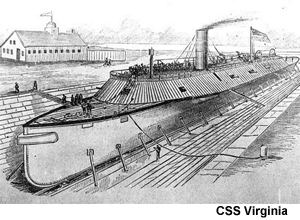
is a drawing of Virginia, as it was.
You'll note that the iron
cladding was around the superstructure, but that the decks were wood. At
the beginning of the Civil War the U.S. government evacuated the Gosport
Naval Yard, Norfolk Naval Yard.
At the time, USS Merrimack,
a single-screw sloop, was in the dry dock.
They attempted to destroy it buy
burning, but they only burned it down to the water line.
The hull was still usable.
Merrimack was not a good
ship in the sense that it had a lot of mechanical problems.
That was the reason why it was
in the dry dock. The Confederacy
decided to build an ironclad on the hull of Merrimack in June
1861. CSS Virginia, as it
was renamed, was commissioned in 1862. This
is a drawing of Virginia, as it was.
You'll note that the iron
cladding was around the superstructure, but that the decks were wood.
The Union became aware of the Confederates' plan to build the ironclad.
Gideon Wells, Secretary of the
Navy, created a board of three members called the “Iron Clads” in August
of 1861, and they selected three designs to be built with the money that
Congress appropriated to do so. Iron
Sides and Galena were both conventional wood ships with
armored sides. However,
Monitor was unique and it was selected.
The reason it was selected was because it could be quickly built
and at a relatively reasonable cost – $275,000.
Most of the ship was below the waterline.
Indeed, it was only 18 inches
from the deck to the waterline.
That is called freeboard. This
low profile, obviously, gave it an opportunity to inflict a lot of
damage while making it a hard target to hit.
I guess you could call it really a submarine in many respects.
Most of the ship was below the waterline.
The other unique feature was the
turret, which could sweep 360 degrees, going completely around.
As a result, it was no longer
necessary to turn a ship in order to deliver a broadside.
That was a huge change in the
concept about naval warfare. Prior
to that, almost all the ships had cannons on the sides of the ships,
“broadsides.” They would have to
turn the ship around in order to achieve broadside fire.
This is truly a unique and
important development in naval warfare.
General Characteristics
Built:
Continental Iron Works, Greenpoint Brooklyn
Ordered:
October 4, 1861
Launched:
January 30, 1862
Commissioned:
February 1862
Dimensions:
179 ft long (LOA), 41 ft wide(beam) with 10 ft draft
Crew:
49 officers and enlisted men
Armament:
2 X 11in (280 mm) smoothbore Dahlgren cannons
Armor:
Turret 8 in., Waterline belt 3.5 in. Deck 1 in., and Pilot house 9 in.
Sunk:
December 31, 1862 in storm off Cape Hatteras
She was built at the Continental Ironworks in Greenpoint, Brooklyn.
It really wasn't built all at
one location. The engines were
built at another contractor. The
bottom of the ship was built someplace else.
It was all married together at
Greenpoint. Monitor
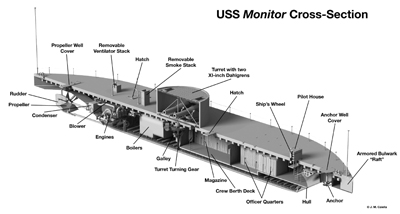
was 179 feet long and was 41 feet wide.
There was a crew of 49, six officers and forty-three enlisted
men. All of the sailors were
volunteers. There were only had
two guns, 11-inch smoothbore Dahlgren cannons.
They could only be fired one at
a time. The turret had 8 inches of steel armor.
The water line steel armor belt
was 3½” and the deck had 1” of armor. The
pilot house had a 9-inch steel cover. If
you look at the drawing, you'll see the smokestack and two vents to
discharge the gases from the engine. These
were removed for battle. The
engines and boilers were below the waterline along with everything else.
The environment was very hot and crowded.
The rotation mechanism of the turret could be operated from within the
turret itself. There were metal
shutters that would close when they were loading the cannonballs.
When I was looking into this, I
found it interesting that they put a hole in each of the shutters so
that the crew could load the cannon and use sponges on long poles that
could poke outside of the turret. The
ceiling was made of iron rails, spaced apart to allow light into the
turret, otherwise there was no way to see within the turret.
One of the things which was also interesting is that because of the
small space in the turret, they used a compressor system to break the
recoil so that the cannon would not go all the way back to run into the
back of the turret. There was a
braking system which used the wood center rails to suppress the recoil
using a screw system. A wheel on
the side of the cannon was used to screw the cannon in place.
Erickson was very concerned
about the possibility of a significant recoil.
He convinced the government only
to use 15 pounds of powder per shot rather than what they wanted to use
which was 25 pounds. This
limited the effectiveness of the cannon fire in the battle with
Virginia.
On January 30th, 1862, the ship was commissioned.
Lieutenant Warden was designated
commander. The ship left the
Brooklyn Navy Yard fully provisioned on March 6th to head
south. It was a difficult
passage. There were several
storms. The ship obviously,
because of the low water line, had a lot of difficulty.
It became almost swamped on
several occasions. Monitor
had to be towed by another ship back into the security of a coastal
port. But the ship went along
the coastline of New Jersey then around the Delmarva Peninsula and
finally on March 8th at about nine o'clock in the evening
arrived at Hampton Roads.
I am sure you are aware the Union strategy was to blockade the
Confederate ports (the “Anaconda” strategy). The Union blockade of
Hampton Roads ran from Fort Monroe on the north down to the southern
shore of the James River. On the
first day, Virginia sallied forth on March 8th at
approximately 3 PM. One has
to recognize that Virginia, as well as Monitor, moved very
slowly. Top speed was 5 knots,
which is about 5.75 miles per hour.
These guys were really going slow!
As matter of fact, Virginia
left port at about 8 o'clock in the morning, and just got into position
to attack in the afternoon. On
the first day, USS Congress, a wooden steam frigate, engaged with
some initial broadsides, trying to impact Virginia with little or
no success. The cannonballs
bounced off Virginia. Virginia then turned its attention
to USS Cumberland, another frigate.
She proceeded to run at and ram
Cumberland and caused it to sink.
Both Cumberland and Congress, were built about the
same time, about 1841 - 1842. They
had traditional broadsides with about 50 guns each.
They were obviously wooden
ships, sailing ships, for the most part.
After sinking Cumberland, Virginia went back to
Congress, which had purposely run aground, and bombarded the ship
with what was called “hot shot.” This
was solid cannon balls heated up until they glowed red.
Then they fired this shot at Congress to cause the target
to catch on fire. The victim
continued to burn through the night, and around midnight it actually
exploded. Minnesota,
which was coming to aid the two ships ran aground and was bombarded as a
stationary target by Virginia.
Virginia withdraws, as it becomes dark, and obviously
Monitor arrives.
Virginia
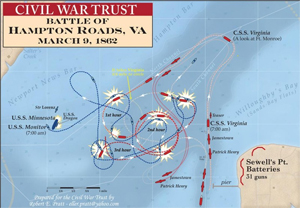
headed the next day, March 9th, for Minnesota to
complete its destruction. But
Monitor, which had arrived the night before, stayed in front of
Minnesota, and started to exchange fire with Virginia.
Thus began the epic duel between Monitor and Virginia.
All of this happened at very
close range. The illustration
shows how they went back and forth and around and maneuvered, each one
trading off cannon fire with the other.
Virginia at some point attempted to ram Monitor
without success. Monitor
tries to damage Virginia's propellers, also without success.
Almost at the conclusion of this
go-around, a shell from the Virginia explodes at the wheelhouse, and
Lieutenant Warden is injured. At
that point Virginia takes off and heads back to the Elizabeth
River. Both sides claim
victory. But the Confederacy
fails to lift the blockade. The
presence of the Monitor assures this could not be done.
The importance of this dual is the impact on naval construction.
The battle spelled the end of
the naval wooden sailing ship. Naval
ships would all be “iron-clad.” The
Union, as well as the Confederates, both built iron-clad ships.
And, as you know, there's a
whole series of monitors which were modeled on Monitor.
Turrets were being used to mount
guns rather than broadsides.
Monitor
was to be towed to Beaufort, South Carolina, to join the blockade there.
While being towed in high seas
on December 31st USS Monitor sank off Cape Hatteras,
NC. The wreck was located in the
1940s. Interest developed in the
1970s about raising the ship or raising a portion of it.
At that point, the anchor was
recovered. In 1990s, the Navy
undertook the raising of the turret, all 120 tons.
This occurred in 2002. When
the ship sank, the turret turned over. The
turret was not attached to the ship, but was, in order to turn, mounted
on a circular brass base called a barbette.
Two cannons were still in the
turret when it was raised.
The turret is today undergoing restoration at the Mariner’s Museum in
Newport News, Virginia.
Last changed: 06/15/26 |