Volume 39, No. 9 – September 2026
Website:
www.CivilWarRoundTablePalmBeach.org
President’s Message
Our summer hiatus will continue in September.
There will be no meeting in
September. Our next meeting will
be on Wednesday, October 14, 2026. Our
speaker will be the ever-popular Patrick Falci.
His programs are always
interesting and informative. I
look forward to seeing all our members at the October meeting as we give
Patrick a big welcome.
Gerridine LaRovere
Photography and Artists During the Civil, War
Many photographers during the Civil
War-Matthew Brady, Alexander Gardner, Timothy O’Sullivan, George
Baernard, and Andrew Russell- were among the most distinguished.
They followed the armies in an
attempt to capture the conflict in various images.
Soldiers were photographed in
camps, on the march, in the trenches, building fortifications and dead
on the battlefield. Mr. Brady was
noted for photographing wounded soldiers and the fatally wounded.
“Mr. Brady has done something to
bring home to us the terrible reality and earnestness of war.
If he has not brought bodies and
laid them in our dooryards and along the streets, he has done something
very like it,” wrote a correspondent for the New York Times after
visiting the famed photographer’s Manhattan gallery in October of 1862.
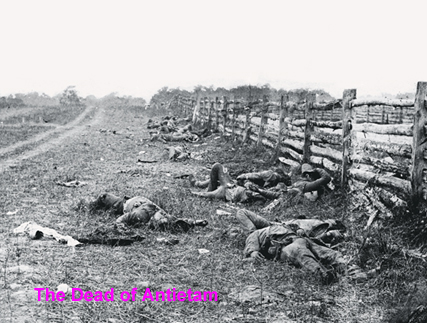
Mr. Brady was showing an exhibit
called “The Dead of Antietam” which showed grisly images of the
devastation. While their bulky
equipment and delicate wet-plate collodion process that their cameras
employed posed challenges in the field, Civil War photographers were
prolific. By War’s end they took
an estimated one million images of sights that most people had never
seen. Many of the photos were
portraits that were coveted by soldiers as well as their families and
friends.
While Civil War photographers could capture
clear shotes of motionless soldiers, structures, and vistas with their
bulky equipment, scenes of action were the specialty of wartime artists
who used less sophisticated means: pencil, pen, and charcoal.
Dispatched to the front by newspaper publishers, these artists
also known as special correspondents, recorded a wide variety of scenes
from mundane happening in camp to gripping views of combat.
Finished sketches were forwarded to the
publisher’s office where staff artists created engravings of the
drawings for printing.
Within weeks the scenes would appear in one of the country’s illustrated
newspapers such as Harper’s Weekly and Frank Leslie’s
Illustrated Newspaper.
The job was taxing and dangerous as it was
exhilarating. Artist Theodore
Davis was twice wounded while sketching a battle.
He described the job’s
requirements as “total disregard for personal safety and comfort; an
owl-like propensity to sit up all night and a hawky style of vigilance
during the day; capacity for going on short food; willingness to ride
any number of miles on horseback for just one sketch, which might have
to be finish at night by no better light than that of a fire.”
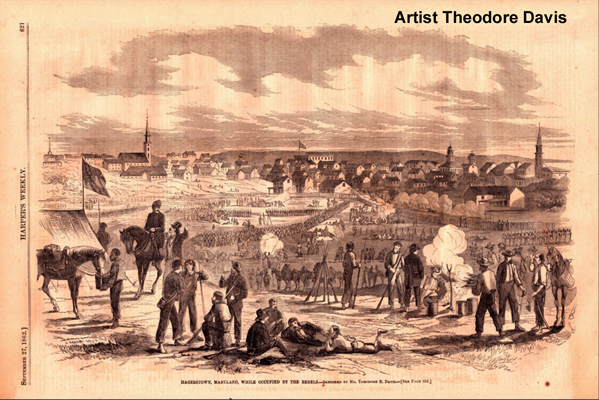
By conflict’s end, war artist compiled an
impressive volume of work which kept the public more closely apprised of
the nature of the conflict. Many
artists became household names including Alfed Waud, Winslow Homer, and
Thomas Nast.
Last changed: 09/02/26 |